

The Shared Armrest
On Sinners and a love that couldn't see daylight

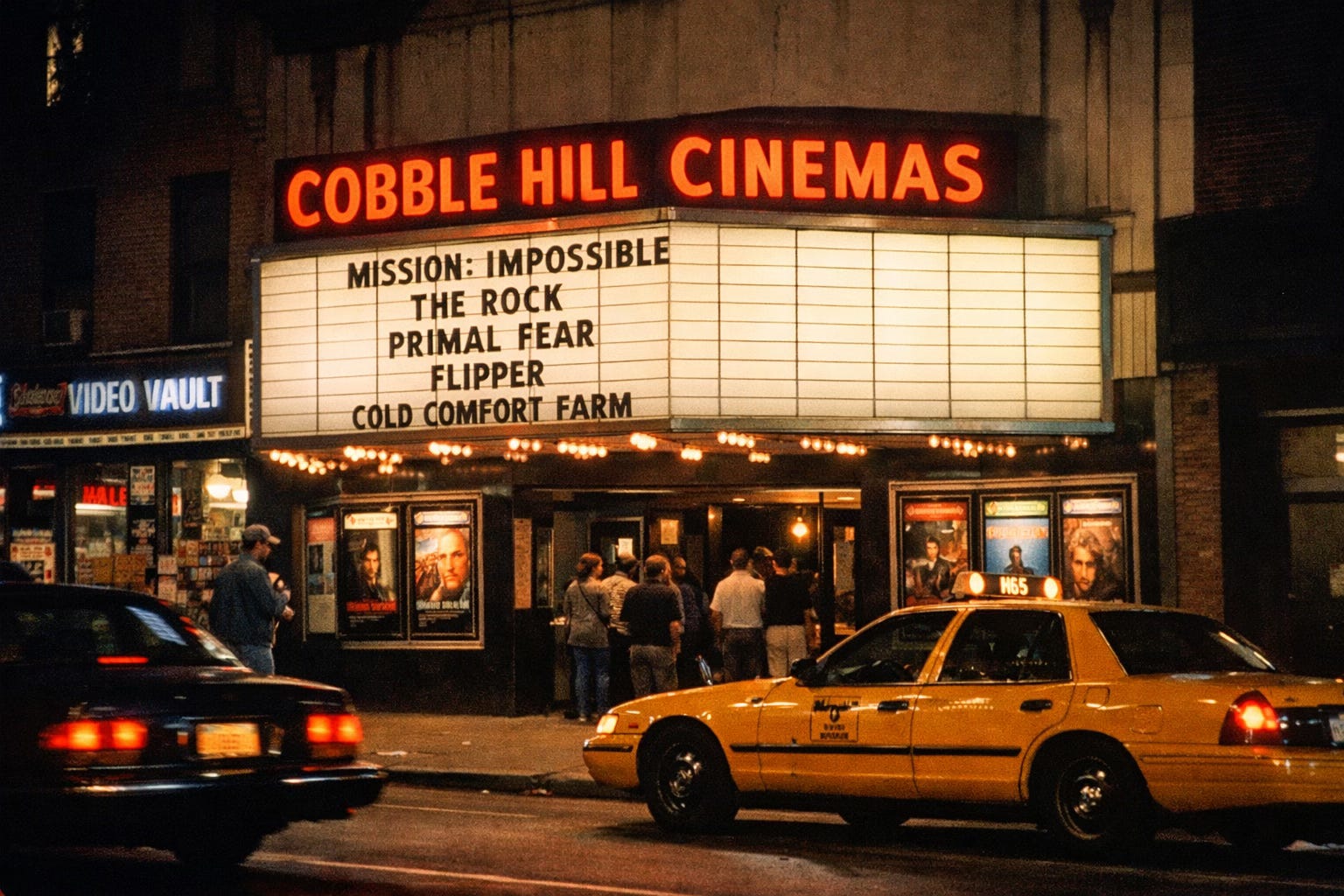
I never took the married man to the movies.
If I had, we would have gone to the Cobble Hill Cinemas, a small, five-screen movie house on the corner of Court and Butler Streets. Once, long ago, I used to sit in the dark by myself during this or that matinee. Or I’d meet a friend from the neighborhood. Or I’d go on a date with a guy, and then we might or might not have dinner afterward. Back when I dated, of course. Back before there was anything resembling an app, swiping, likes, or hearts. Back before we stopped meeting IRL and hovered like ghosts behind the screen. Back before I realized just how precious it was to meet someone in a gym in 1996 and get that first jolt of electricity that no amount of swiping could ever produce.
I used to run into the married man more often than I can count after leaving the movies. There he’d be, having just picked up cookies at D’Amico’s or College Bakery—and we’d say hey. We were always saying hey to each other.
Sometimes, it’s the hey I miss the most.
But the movies. It’s what I return to now in my Airbnb in a town in Texas, where I’m about to watch Ryan Coogler’s Sinners. I’m alone again in the dark, just how I always sat when it came to him—alone, in the dark, wanting. I think about what it would have been like to be beside him in that theater in those uncomfortable chairs whose springs had sprung ages ago, our arms not quite touching on the shared armrest, the specific discipline of not touching, which was its own kind of intimacy, maybe the most intimate thing I ever knew.
He was gorgeous. He was married. He was the best thing in my world for thirteen years, and he was never mine in any way that counted, which is to say: in daylight. So it makes perfect sense that Sinners speaks to me. After all, it’s a film about what people will bleed to death for. Literally—there is so much blood, so much beautiful, terrible blood—but also figuratively, in the way that all great art is about both things at once.
Ryan Coogler has made a movie about desire as a force of nature, about music and hunger and the particular madness of wanting something you have been told you cannot have. The vampires in this film are not the villains. They are the consequence. They are what happens when you reach for the light anyway.
I understood this in my body before I understood it in my mind.
What would it have been like, I keep wondering. The theater going dark. His shoulder near mine. Onscreen, men bleeding for love, for music, for the unbearable desire to be fully seen. I would have watched him watching it. I would have catalogued the way the light moved across his face. I would have been so careful not to want him too loudly.
We were careful for thirteen years. He was careful in the way that married men are careful—meaning, not always, not completely, but careful enough to keep his life intact. I was careful, like people are when they’ve accepted an arrangement they didn’t choose—perfectly, tragically—until it ended, and I was left holding all that care with nowhere to put it.
In Sinners, there’s a moment when the music becomes impossible to resist. It seeps through the walls of the juke joint. It calls to people who know better, but they come anyway. They can’t help themselves. They choose the music over their survival, and the movie doesn’t judge them for it. It understands. Some things are worth bleeding for.
I would have reached for his hand in that theater. I know I would have. Sitting in the safe darkness, with a story about desire on screen doing all the work of explaining what neither of us could say—I would have reached for him, and maybe, just this once, in the dark, he would have let me.
But I never took the married man to the movies.
It’s true. We met at a gym in Boerum Hill, and for thirteen years, I loved him in the only way I knew: friendship, proximity, the unique brightness I sensed in every room he entered. I gave him so much of myself that I became unrecognizable even to myself. I didn’t know how to want less of him. I didn’t try very hard.
He vanished in 2009. One day he was there, and then he simply wasn’t, like a light going out—no warning, no ceremony, no goodbye. I walked past him on Court Street that summer, and he let me keep walking. I kept walking. I haven’t really stopped.
Sinners ends in light. After all the bloodshed and darkness, there is light. I won’t tell you what it costs, only that Coogler seems to believe—or at least insist, in a way only films can—that some loves are worth every price they demand. That wanting isn’t the same as weakness. That reaching for the light, even knowing what it might do to you, is the most human thing there is.
Now, so many years from that theater and Court Street and Cobble Hill, I sit alone in my little Airbnb with the credits rolling and Sammy strumming, and I think: I would have given anything to be in the dark with him, just once, reaching. That’s all I ever wanted, really. The dark, and then the light, with him beside me, and we both brave enough to want each other—through the nights and the days and the nights again.
"I would have watched him watching it. I would have catalogued the way the light moved across his face. I would have been so careful not to want him too loudly." -a fusion of poetry and prose heartbreak reflection longing. The glistening light of something you write is going to capture the heart and obsession of a filmmaker and one if not many of your pieces will be adapted into a screenplay, feature film, or strand of streaming vignettes. when trying to describe the feeling I get from reading 📚 your pieces all I can say is, you had to be there. because you transport me to a place a trance - hypersuspended in a yesteryear. in short.. it's lovely. again. thank you for sharing.